
How many extra orders did your marketing bring in?
Use your sales records and menu links to estimate how many orders a campaign added and how many you need to cover its cost.
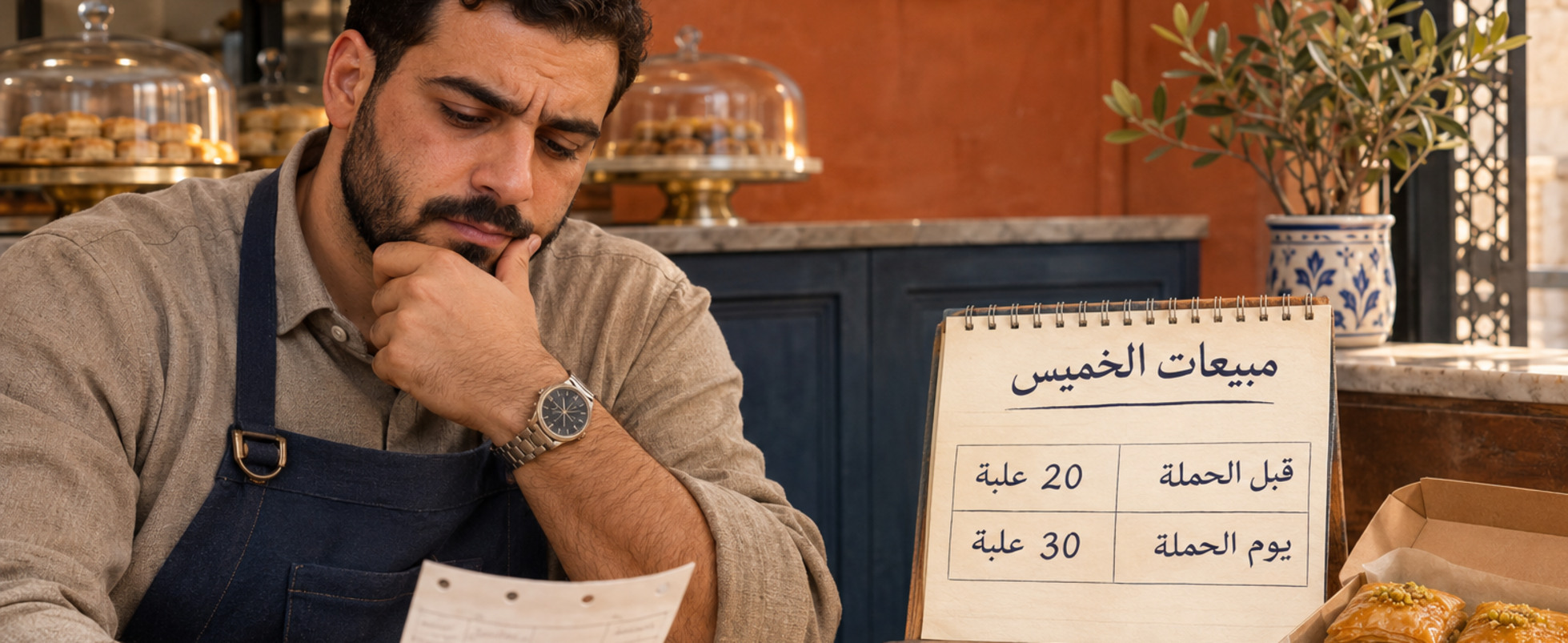
You post a video of your gift box of sweets on Thursday. By sunset, you’ve sold the last one. Should you make another video next week? First, ask your cashier how many boxes you usually sell on a Thursday. If you sell out most weeks, an empty shelf tells you little about what the video achieved.
01 Start with a typical Thursday
Pull the last four weeks of sales if you have them. For each day, record how many orders you filled, their total value, and how many boxes of the featured item you sold. Keep a separate tally for each branch. Say you usually sell 20 boxes on Thursdays and sold 30 the day the video went up. That gives you 10 extra boxes to investigate. Ask the cashier who worked that shift whether anyone placed a large order for guests, the price changed, or the shop stayed open late.
Eid deserves a comparison of its own. A regular customer might buy three boxes for family visits instead of one. Sales can rise even if roughly the same number of people come through the door. Compare the days before Eid with the same point in a previous Eid season if conditions were similar. For a new branch, flag the holiday in your records and see what holds up once normal hours resume.
02 What happened after the click?
Give your Instagram Story its own tracked menu link so you can tell its visits apart from those coming through your bio. Set up the menu to record taps on “Order on WhatsApp” and “Open delivery app.” Test the journey on your phone before you publish. You can then see where visitors came from and which ordering option they chose.
Suppose the Story brought 80 menu visits and the WhatsApp button recorded 20 taps. Someone may have tapped twice or opened a chat and left. To connect those taps to sales, prefill the WhatsApp message with the box name and a campaign code. Ask the person taking orders to record the code when an order is confirmed. If your delivery app reports completed orders from a referral link, check that report too. Without it, opening the app is the last step you can verify from the link.
03 Did you get more orders, or did customers order differently?
Record where each order came from: the counter, WhatsApp, or a delivery app. In a separate column, record how the customer received it: at a table, by pickup, or by delivery. A box ordered on WhatsApp and delivered by a driver counts once.
If app orders rose by ten while counter orders fell by ten, your total stayed the same. Check the app commission and how much you kept on each sale. Likewise, finding the video’s code on eight orders tells you eight orders used it. To estimate how many of those customers would have bought anyway, look at sales on comparable days and across branches.
04 How many boxes cover the cost of the campaign?
Suppose you sell a box for 50 shekels and keep 20 after ingredients, packaging, and any commission or delivery costs you cover. At that margin, a 2,000-shekel campaign needs to generate 100 additional box sales to pay for itself. If you keep less on app orders, run the calculation using the mix of orders you actually received.
Use that figure to guide your weekly review. If plenty of people visit the menu but few place an order, open it on a customer’s phone. Can they find the price? Can they tell whether you deliver to their neighborhood? Showing the delivery fee upfront may do more for sales than filming another video.
05 What the first month with Yoosal looks like
We agree on the scope with the restaurant owner before work begins. In week one, we review sales by day of the week and choose one item to focus on. We prepare the filming equipment, write the first one or two video scripts, and storyboard the shots so the team knows what to film and why. Before the videos go live, we set up the links and test that each order button records a tap.
After launch, we sit down with the owner each week and compare menu activity with completed orders. That helps us decide whether to film another video for a box that’s selling well or fix a step where customers are dropping off. If you have an item in mind, bring a typical week’s sales figures to your first consultation with us. We’ll use those numbers to work out what level of investment makes sense for your restaurant.